
This is one of a three-part series on WooCommerce MCP. This post describes what MCP is, how it works, and how to get started with the built-in capabilities. The second part deals with building your first custom abilities. The third part goes deeper with advanced demos and production considerations.
I took a deep dive into something really exciting in WooCommerce: Model Context Protocol (MCP) integration. MCP was first shipped as a beta in 10.3 and is maturing across releases. Now, with WooCommerce 10.7 and WordPress 6.9+, the stack is solid enough to build some really useful stuff on top of. So I went ahead and did just that.
Imagine this: we chat with an AI assistant and say something like “Show me my low stock products“gold”Create a product called Winter Hoodie for $39.99.“Our WooCommerce store is responsive, does work and returns results. No clicking through the WordPress Dashboard, no manual REST API calls. Just natural conversation translating into real store actions.”
This is made possible by MCP. Throughout this post, I’ll be using Claude Code as the AI assistant, but MCP works with any compatible client: cursor, VS Code, or anything else that speaks the MCP protocol. Use whatever works best for you.
Let’s explore it together!
Think of MCP as a universal translator between AI tools and our WooCommerce store. Normally, if we want an AI to interact with our store, we need:
- Build your own REST API integrations.
- We can handle the authentication ourselves.
- Write lots of code to parse the responses.
MCP changes all that. It is an open source standard that allows AI assistants like Claude, Cursor or VS Code to talk directly to systems like WooCommerce using natural language.
With MCP:
- Artificial intelligence can discover what our store can do.
- Artificial intelligence can perform these actions safely.
- Everything works within our existing permissions.
So when we say, “List all products under $20 USD,” MCP converts it into something WooCommerce understands, runs it securely, and returns results.
Three parts work together to make this happen, all building on top of WooCommerce’s existing security.
Building blocks
WordPress Abilities API
The WordPress Abilities API is a way for WordPress plugins to register “Abilities”, basically things they can do. Think of it as a menu: WooCommerce tells WordPress, “Here’s everything I can do,” and AI assistants can read that menu and pick what they need. Each ability has a name like:
woocommerce/products-list: list of all productswoocommerce/orders-create: create a new order
The Ability API shipped in WordPress 6.9 as a core feature. It provides a standardized registry that any plugin can plug into, so WooCommerce no longer needs to package it separately. For those building their own abilities, they are registered at wp_abilities_api_init hook (more on that in the second part of the series).
WordPress MCP adapter
The MCP adapter is a translator. It takes MCP messages from AI assistants and converts them into something WordPress understands. Think of it as an intermediary that speaks both “AI protocol” and “WordPress”.
WooCommerce REST API
Current MCP capabilities bridge existing REST API endpoints. This means that the existing REST API permissions still govern everything and security remains exactly the same.
In the future, capabilities can go beyond REST and do even more powerful things. But for now, it gives us a solid and secure foundation.
Communication flow
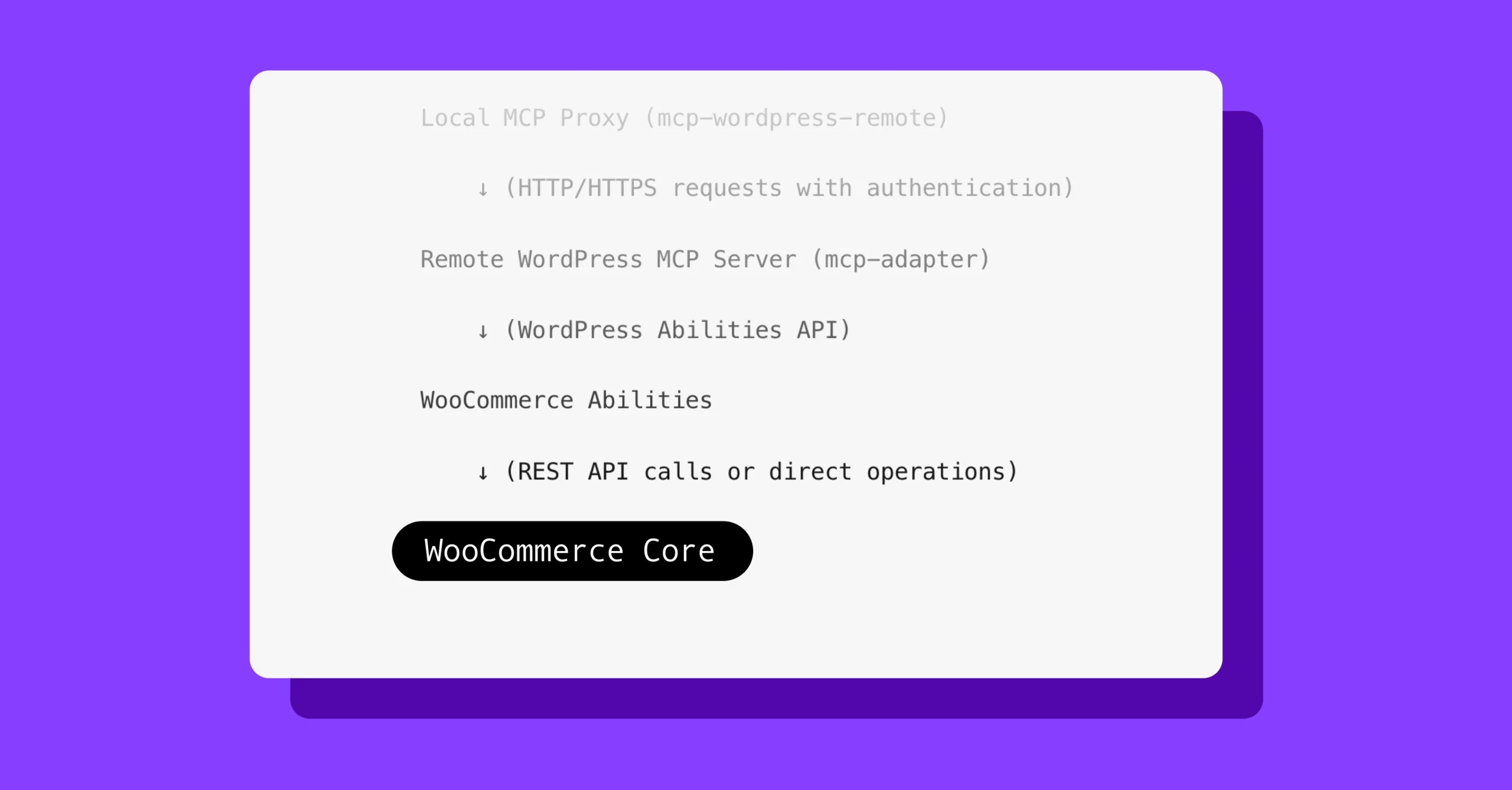
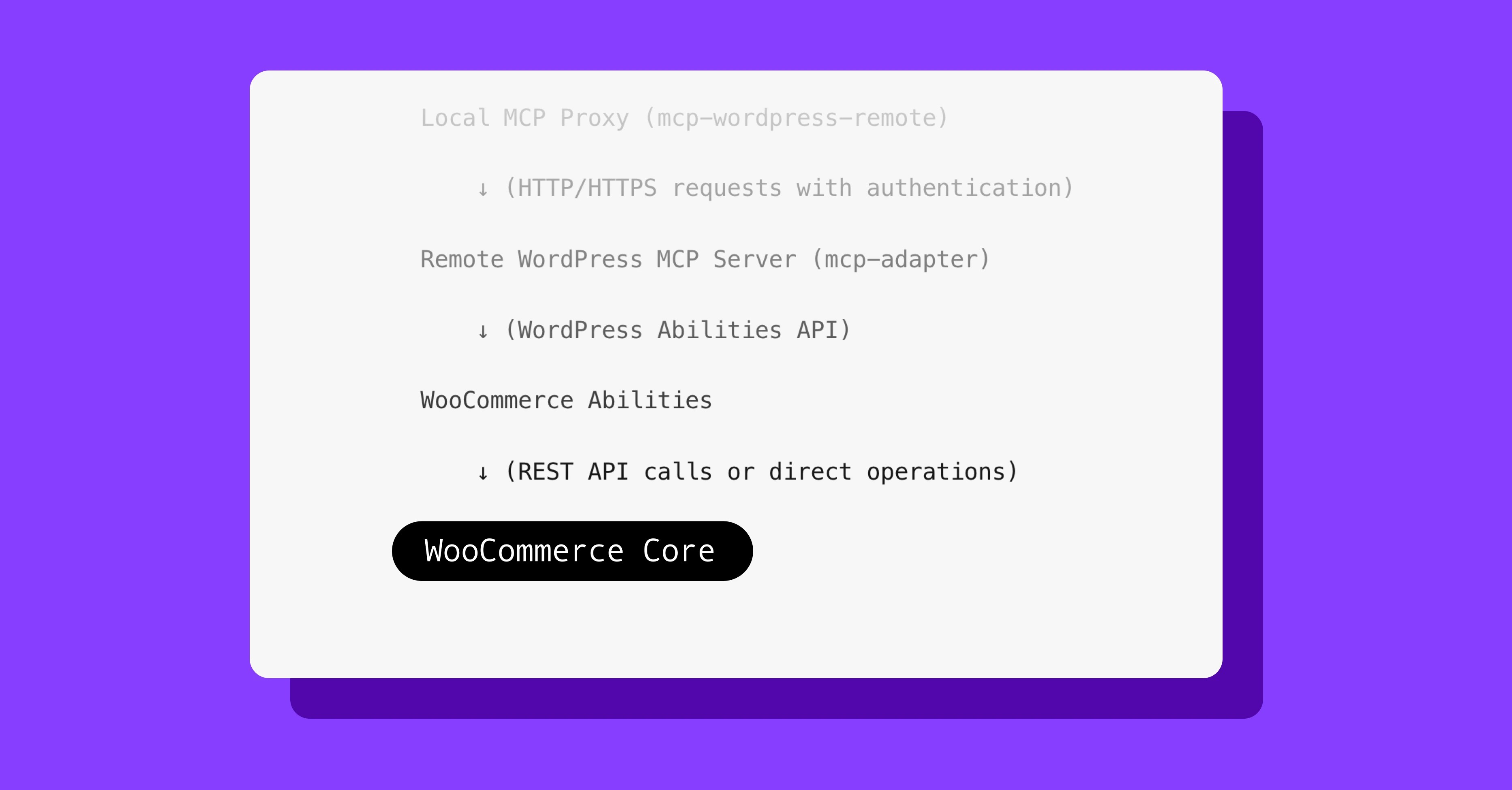
When we enter “list of all products” into Claude Code, this is what happens step by step:
AI Client (Claude, etc.)

    ↓ (MCP protocol over stdio/JSON-RPC)

Local MCP Proxy (mcp-wordpress-remote)

    ↓ (HTTP/HTTPS requests with authentication)

Remote WordPress MCP Server (mcp-adapter)

    ↓ (WordPress Abilities API)

WooCommerce Abilities

    ↓ (REST API calls or direct operations)

WooCommerce Core
Simply put, Claude Code sends a message to a small proxy tool running on our computer. The proxy converts it into a secure web request and sends it to the MCP endpoint of our WordPress site. The MCP looks up which ability to run, makes a callback to the ability (querying orders, products, etc.) and returns the result the same way back.
Local proxy (@automattic/mcp-wordpress-remote) is a small Node.js tool that we install once during installation and then forget about. Its job is to translate between how AI clients communicate (stdio) and how WordPress works (HTTP).
MCP landed as a beta in WooCommerce 10.3 with product and order capabilities. The update since then was the migration of MCP Adapter v0.3.0 in 10.4, which updated the transport layer. Since then, the MCP surface has been stable up to 10.5, 10.6, 10.6.1 and 10.7, which we’re building on.
MCP is still active developer previewso built-in capabilities are limited to product and order CRUD (create, read, update, delete). But the foundation is solid, and this is where Custom Abilities come into play.
Out of the box, WooCommerce comes with nine MCP capabilities:
Products:
woocommerce/products-listproducts-getproducts-createproducts-updateproducts-delete
orders:
woocommerce/orders-listorders-getorders-createorders-update
This is already powerful enough to create really cool workflows. But where it goes is really interesting Own abilitiesand we’ll dive into that in part two of this series.
Prerequisites
- Work Page (WooCommerce MCP is in Developer Preview)
- WooCommerce 10.7 (or 10.3+)
- WordPress 6.9+ (for basic Ability API)
- Node.js 22+ (requires latest
mcp-wordpress-remote) - A REST API key with read_write permissions
- MCP client (I use Claude Code). Note: Claude Code requires Claude Pro or Max plan ($20/month+) or Anthropic API credits. Not available on the free tier.
MCP permission
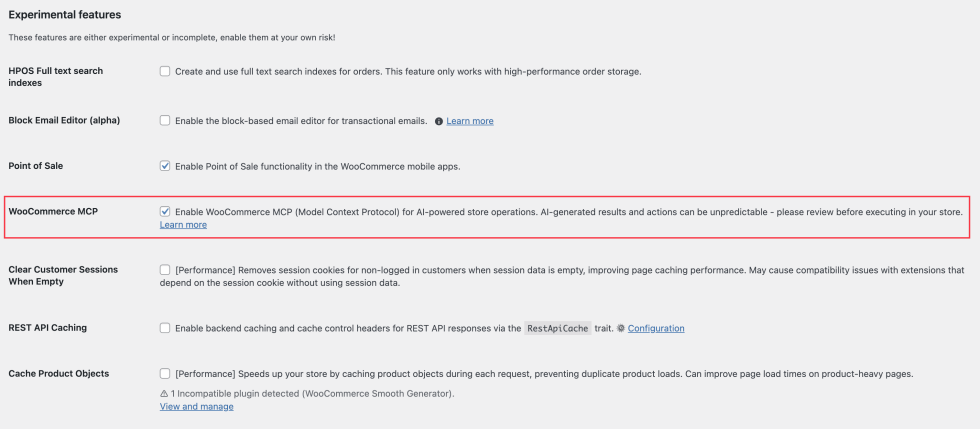
Option 1: Head to WPAdmin > WooCommerce > Settings > Modern > Features and enable WooCommerce MCP.
Option 2: Allow via WP-CLI
wp option update woocommerce_feature_mcp_integration_enabled yes
Connection settings
Create an API key
- In your store’s WP Admin dashboard, go to WooCommerce > Settings > Modern > REST API.
- Click Add key.
- Set permissions to Read/Write.
- Impose consumer key and secret.
Configure Claude Code
Open a terminal and run:
claude mcp add woocommerce_mcp \

  --env WP_API_URL=https://yourstore.com/wp-json/woocommerce/mcp \

  --env CUSTOM_HEADERS='{"X-MCP-API-Key": "YOUR_CONSUMER_KEY:YOUR_CONSUMER_SECRET"}' \

  -- npx -y @automattic/mcp-wordpress-remote@latest
Important:
- Replace
yourstore.comwith the current test site URL. - Replace
YOUR_CONSUMER_KEY:YOUR_CONSUMER_SECRETpart with the actual API credentials. - Restart Claude Code to load the new configuration.
For local development with HTTP: To test locally without HTTPS, add this filter:
add_filter( 'woocommerce_mcp_allow_insecure_transport', '__return_true' );Let’s explore the default capabilities that come with WooCommerce. These work instantly with zero custom code.
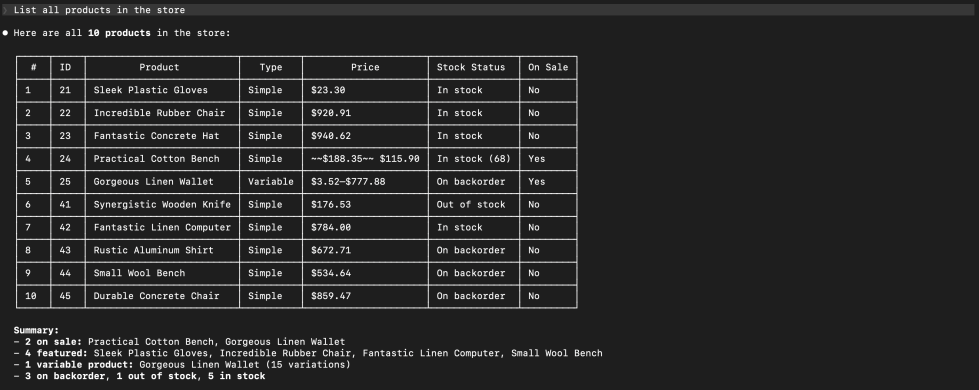
List of all products
Ask the AI customer: “List of all products in the store.”
What’s happening behind the scenes:
- MCP calls the ability:
woocommerce/products-list - Returns product data with names, prices, stock status, etc.
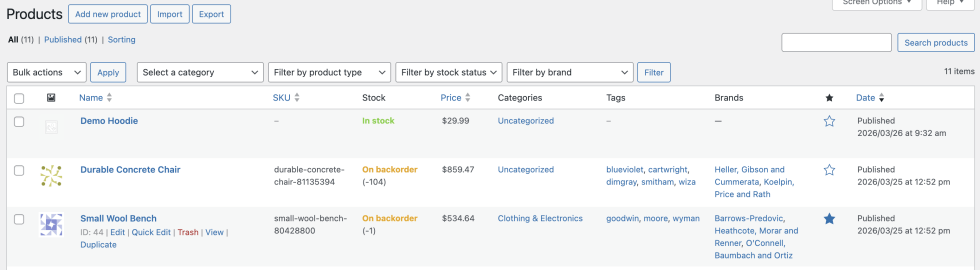
Create a product
Try this: “Create a product called ‘Demo Hoodie’ priced at $29.99.”

MCP call:
- Ability:
woocommerce/products-create - Result: A new product appears in the store!
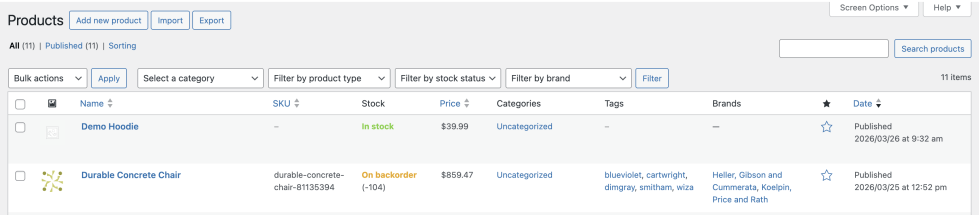
Update the product
Say: “Update the demo sweatshirt price to $39.99.”
MCP call:
- Ability:
woocommerce/products-update - The price will change immediately!
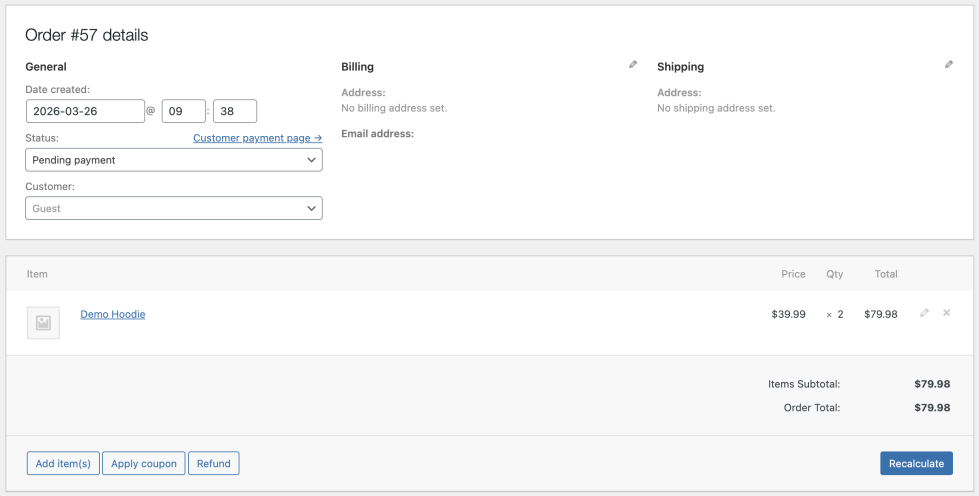
Create an order
Try: “Create an order for product ID 56 with quantity 2.”
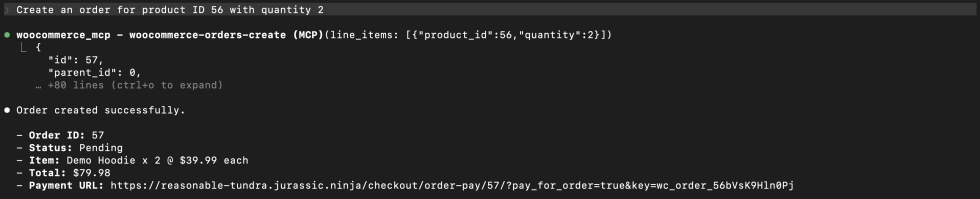
MCP call:
- Ability:
woocommerce/orders-create - A new order is created!
Pretty amazing, right? These built-in capabilities make AI-assisted store management feel natural. And that’s just the beginning!
In part two, we’ll go beyond the built-in features and build custom capabilities from scratch—including a Today’s Sales Analytics dashboard, low inventory alerts, and a customer prospecting tool. See you there!


Kamlesh is a Happiness Engineer at WooCommerce. He loves helping customers get the most out of WordPress and WooCommerce – the more he sees what’s possible for them, the more excited he gets. Outside of Woo, you’ll find him researching a new technology or gadget, traveling without fixed plans, or watching cricket with disproportionate intensity.