
As a cloud service provider (CSP), your customer base is incredibly diverse. The infrastructure needs of budget-conscious small businesses differ significantly from those of multinationals that require strict data isolation and close governance controls.
To maximize your total addressable market (TAM) and provide the exact level of control, cost and isolation your tenants need, you need a highly adaptable infrastructure strategy.
Below, we break down five different deployment models—from shared infrastructure to dedicated large-scale fleets—to help you structure your service catalog and match your offerings with the right tenant profiles.
1. Consolidated domain
This model can certainly be used to support SMEs for low-cost dedicated infrastructure with full control.
In this base-level model, the management and workload domains are collapsed into a single consolidated footprint. This provides the end user with very simplified consumption while reducing resource overhead to a minimum.
• Infrastructure: Reserved
• Tenant experience: Simplified consumption
• Management Access: Full access
2. Shared workload domains
This deployment model allows CSPs to serve a customer segment, such as small and medium-sized businesses, that are looking for a highly cost-optimized public cloud-style environment with sometimes large capacity needs.
This model maximizes your hardware utilization by hosting multiple customers in multiple workload domains on a shared infrastructure. It’s a classic “public cloud” model that allows you to offer highly competitive pricing by pooling resources, making it ideal for cost-conscious tenants who don’t require strict hardware isolation.
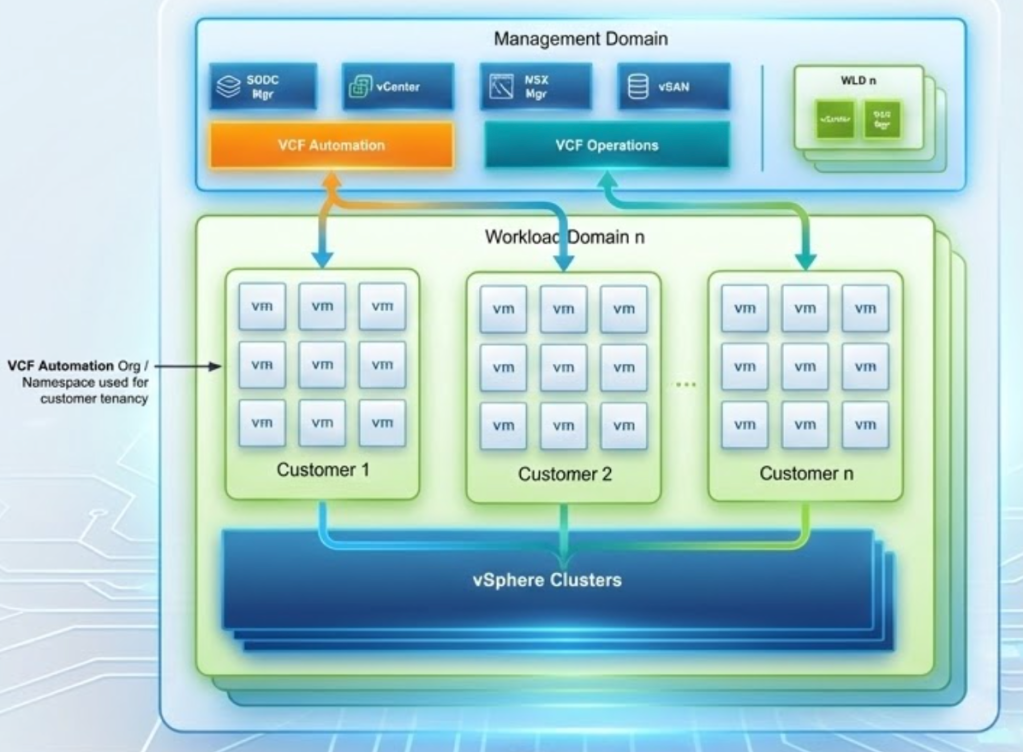
• Infrastructure: Shared
• Tenant experience: Public cloud consumption
• Management access: None (fully managed by CSP)
3. Dedicated workload domains
The main customer base consists of small and medium enterprises to enterprise customers who require strict infrastructure isolation without the burden of management.
For clients with compliance or performance requirements that dictate dedicated hardware, this model assigns individual customers to their own isolated workload domains. It provides a true private cloud experience. However, CSP retains administrative control, making it ideal for organizations that want dedicated performance but lack the in-house expertise to manage the underlying infrastructure.
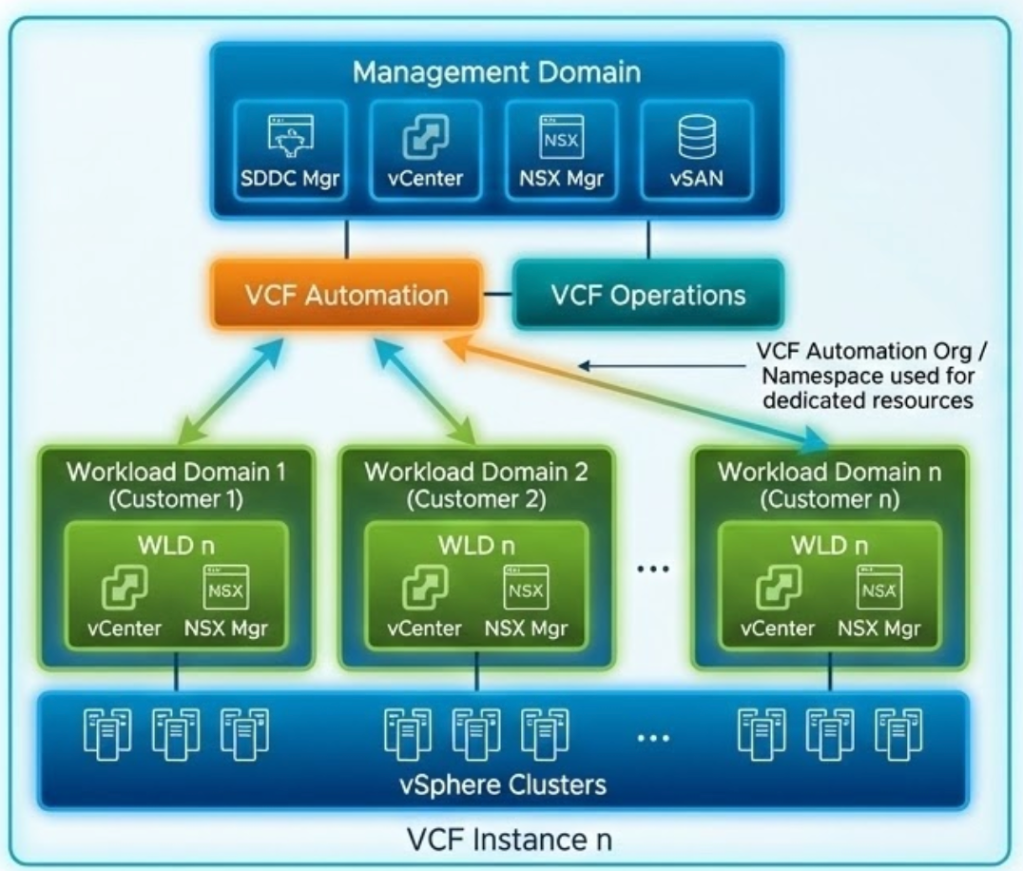
• Infrastructure: Reserved
• Tenant Experience: Private Cloud (Reserved)
• Management access: None / Read only (CSP fully managed)
4. Dedicated VCF instances with centralized fleet management
This deployment model is best suited for large commercial to enterprise customers who need dedicated infrastructure and partial control backed by CSP oversight.
This model offers an excellent middle ground. Each dedicated customer receives their own instance of VMware Cloud Foundation (VCF). However, to maintain operational overhead management for CSP, these instances are managed centrally using a single instance of VCFA/VCFO and Fleet Manager.
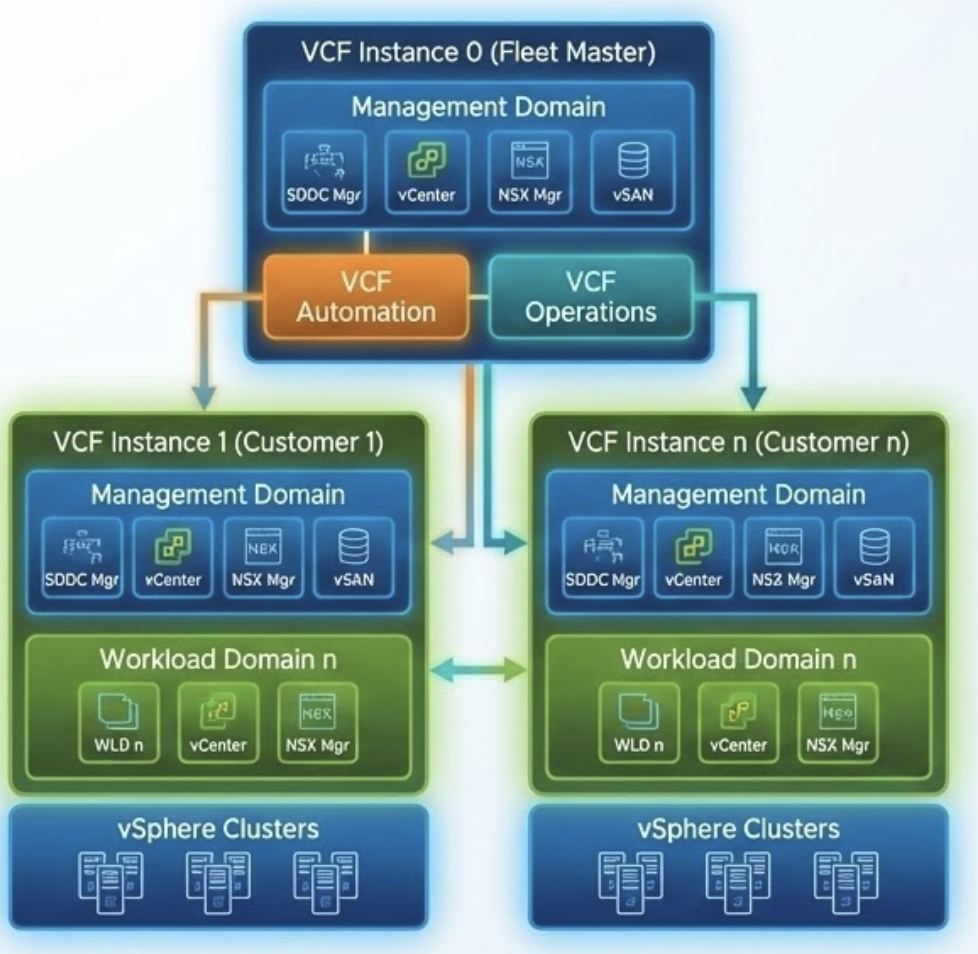
• Infrastructure: Dedicated VCF instances
• Tenant experience: Co-managed private cloud
• Management Access: Partial access
5. Dedicated fleets / VCF instances
This deployment model is best suited for all large enterprises requiring massive scale, absolute isolation and total autonomous control.
This is the highest offering in the CSP portfolio. It involves provisioning one or more VCF instances completely dedicated to a single tenant, including their own isolated instance of Fleet Manager. This model essentially functions as a fully localized, on-demand data center for large enterprises that require unlimited control and scale.
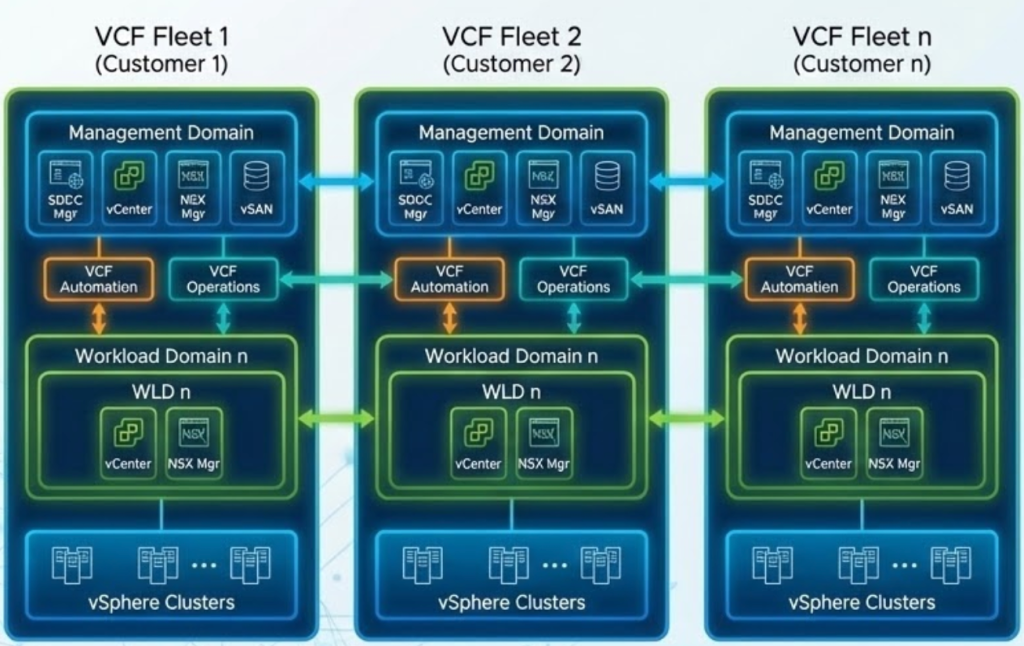
• Infrastructure: Dedicated VCF fleet
• Tenant experience: Enterprise-scale private data center
• Management Access: Full, autonomous access
A quick look at deployment models
Follow the quick reference matrix to match your sales to the right customer profiles:
| Model | Target Tenant | Infrastructure | Access for management | Cost profile |
| Consolidated domain | SMB | Reserved (combined) | Full | Low |
| Shared workload | SMB/SME | Shared | None (managed by CSP) | Lowest (optimized) |
| Dedicated workload | SME / Enterprise | Dedicated | None (managed by CSP) | Medium – High |
| Dedicated VCF (Central) | SME / Enterprise | Reserved VCF | Partial | High |
| Dedicated VCF fleet | Big business | Dedicated VCF + fleet | Full | First |
Summary:
Building a profitable cloud service provider (CSP) business isn’t just about getting the architecture right—it’s how you monetize it. (Blog coming soon..) . If your pricing is too complex, you will lose small and medium businesses; if your packaging lacks flexibility, you will alienate business clients.