
12:00 p.m
4
min reading ▪ acc
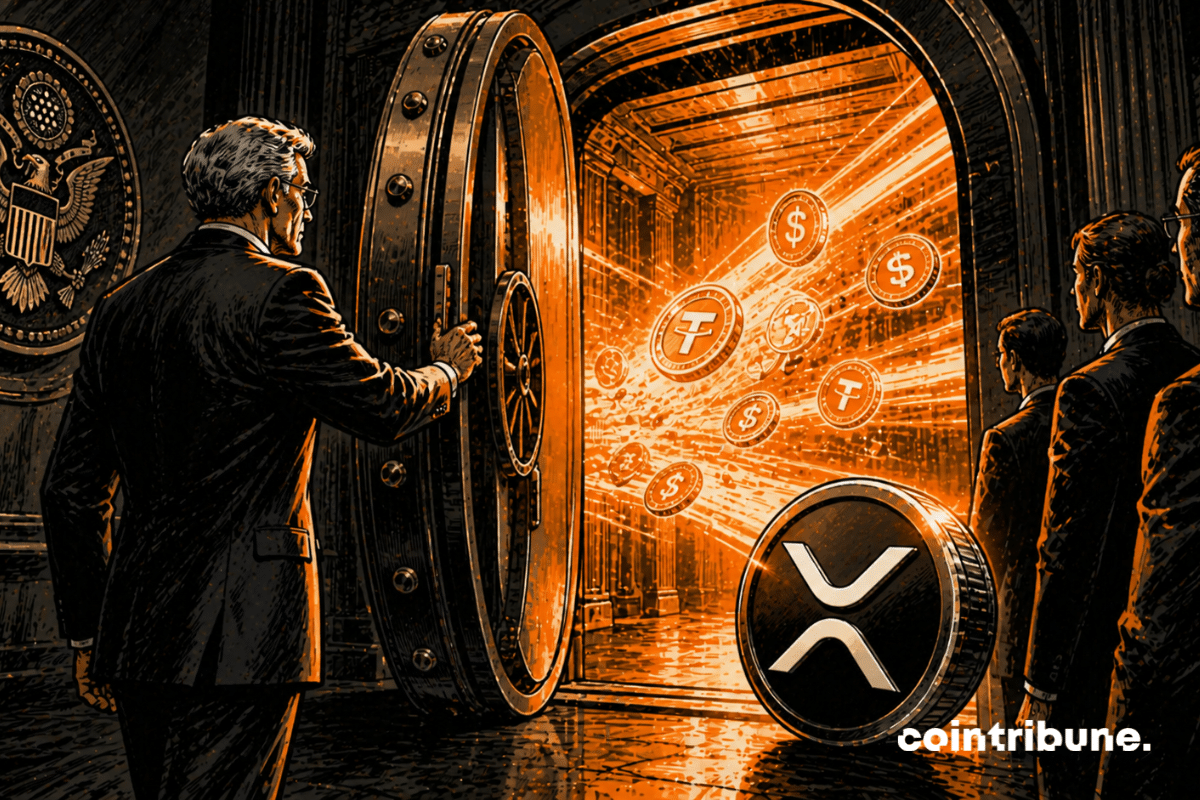
A seemingly innocuous technical reform could fundamentally change dollar payments. In the United States, the idea of opening up access to the Federal Reserve System to certain stablecoin issuers will shake the balance established between banks and fintechs. In this context, XRP re-emerges with an unexpected promise: to become a key cog in the circulation of cash flows. This scenario is still hypothetical and is part of the restructuring of the US financial infrastructure.
In short
- A proposal in the United States aims to open access to Federal Reserve accounts to some stablecoin issuers, challenging the exclusive role of banks in clearing payments.
- Authorities, including the Fed and the FDIC, are working on a structuring regulatory framework to govern these new players and their liabilities.
- In this new model, stablecoins could directly access the monetary infrastructure, reducing middlemen and transaction friction.
- XRP appears to be a technical solution to ensure the circulation of funds after their settlement beyond the existing system.
Towards Direct Access to the Fed for Stablecoins
The debate was reignited by Asheesh Birla, CEO of Evernorth, who described a proposal on X to grant limited access to Federal Reserve accounts to certain stablecoin issuers.
The statement reminds of the importance of this tool : “the master account with the Federal Reserve System is the heart of the payment system. It allows direct access to the settlement of dollars at the source. Today only banks have them. Every payment application must go through a bank to access it ».
This position reveals a potential transformation at the very heart of dollar payments.
Several regulatory elements support this dynamic:
- A March 30 Federal Reserve report examines the use of stablecoins to reduce friction in cross-border payments;
- The described model is based on conversion to stablecoins, simplified conversion and subsequent conversion back to the local currency;
- On April 7, the FDIC approved a proposal regulating stablecoin issuers;
- This framework includes reserve requirements, risk management, capital and asset protection.
These developments are gradually shaping an architecture where stablecoins could more directly access the Fed’s monetary infrastructures.
XRP is envisioned as a means of payment circulation
In this scenario, XRP’s role is not at the settlement level, but at a lower level, in the circulation of funds. Asheesh Birla clarifies this distinction based on the case of the RLUSD stablecoin: “RLUSD is issued by Ripple’s trust company, regulated in New York. This regulatory profile is similar to what the limited access to the primary account at the Federal Reserve assumes.”. adds: “If the proposal is successful and RLUSD is eligible, settlement will continue to occur through the Federal Reserve System. However, XRP will then become a rail to the circulation of the dollar within the payment infrastructure in the United States.”.
This vision positions XRP as a technical tool capable of streamlining financial flows after settlement through the Fed.
This placement is accompanied by a wider financial strategy supported by Evernorth. The company is developing a cashier model based on the Ripple cryptocurrency and has already raised more than $1 billion. It is targeting a Nasdaq listing through a merger with Armada Acquisition Corp. II with the aim of offering regulated and transparent exposures to this asset. This approach reflects the desire to inject XRP into traditional financial markets along with its potential use in payment infrastructures.
Such developments remain dependent on the decisions of US regulators. If this framework comes to fruition, it could redefine the place of stablecoins and cryptocurrencies in the monetary architecture. XRP would not replace existing institutions, but would integrate into their mechanisms and pave the way for a progressive hybridization between traditional finance and blockchain technologies.
Maximize your Cointribune experience with our “Read and Earn” program! Earn points for every article you read and get access to exclusive rewards. Register now and start reaping the benefits.

A graduate of Sciences Po Toulouse and holder of the blockchain consultant certification issued by Alyra, I joined the Cointribune adventure in 2019. Convinced of the potential of blockchain to transform many sectors of the economy, I committed myself to raising awareness and informing the general public about this ever-evolving ecosystem. My goal is to enable everyone to better understand blockchain and take advantage of the opportunities it offers. I strive every day to provide an objective analysis of current events, decipher market trends, convey the latest technological innovations, and put into perspective the economic and social issues of this ongoing revolution.
DISCLAIMER OF LIABILITY
The comments and opinions expressed in this article are solely those of the author and should not be considered investment advice. Before making any investment decision, do your own research.